Minimum Order Quantity Is Not a Barrier: Understanding MOQ and Production Costs in Kitchenware Customization
When brand owners first request quotations from stainless steel kitchenware manufacturers, one of the first questions they usually ask is:
“What is your MOQ?”
But behind this seemingly simple number lies a much more complex production logic.
For buyers, understanding why an MOQ exists is often more valuable than simply asking a manufacturer to lower it.
For stainless steel kitchenware, MOQ is mainly influenced by three factors: production startup costs, customization depth, and fixed-cost allocation.
I. What Determines MOQ? Production Startup Costs & Raw Material Requirements
MOQ is not simply a number manufacturers set to reject small orders.
It is closely related to production setup costs and raw-material requirements.
Whether a factory produces 100 pieces or 2,000 pieces, certain initial costs remain relatively similar, including machine setup, mold installation, production-line adjustment, material preparation and labor scheduling.
For example, when a stainless steel cookware production line switches from standby to production, time and materials are required for setup, testing and adjustment before qualified products can be produced.
If the order quantity is too small, these initial costs are spread across fewer units, significantly increasing the cost per piece.
Raw-material procurement can also create another threshold. Stainless steel sheets, coils and other production materials are often purchased according to supplier and processing requirements rather than in quantities corresponding exactly to a small customer order.
A common question:
“Our brand is newly launched, and we cannot meet a 1,000-piece MOQ. Are there other options?”
A practical solution: Start with modified standard products
Instead of developing a completely new product, consider using existing factory-standard molds and regular materials, then differentiate the product through:
- Custom packaging
- Laser-engraved logos
- Standard-color finishes
- Selected handle or accessory options
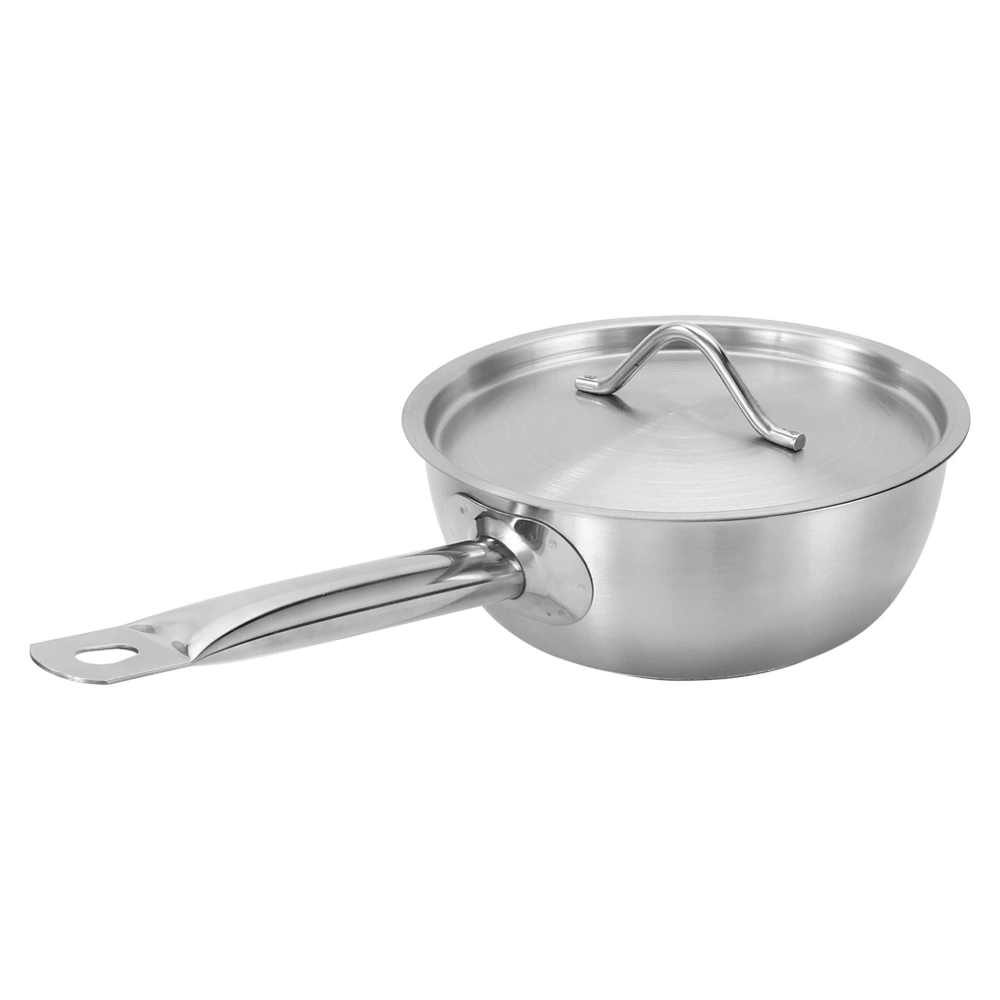
For some stainless steel frying pan models, for example, a lower MOQ may be achievable when the main product structure remains standardized.
This allows a new brand to test the market with a relatively low initial investment before moving into deeper customization.
II. Customization Depth Matters: Not All Customization Has the Same MOQ
MOQ can change significantly depending on how deeply a product is customized.
Adding a logo to an existing product, changing the packaging or selecting from standard accessories generally requires much less investment than developing a completely new product structure.
By contrast, a special-shaped cookware design may require:
- New molds or tooling
- Multiple rounds of sampling
- Production testing
- Material adjustments
- New handles or accessories
- Special surface finishes
- Customized glass lids or silicone components
Each additional customization layer may introduce its own minimum quantity or setup cost.
A common question:
“We want an exclusive cookware design, but the cost of developing a new mold is too high. What can we do?”
A practical solution: Adopt a phased customization strategy
For the initial production run, consider using:
Standard product structure + customized packaging + brand identification
This allows you to establish product differentiation without immediately taking on the full cost of new mold development.
Once sales performance and repeat-order potential become clearer, the next stage can gradually move toward deeper customization at the product level.
In other words:
Start with customization where the investment is lower. Scale into deeper customization when the market proves the demand.
III. Why Does a Lower MOQ Usually Mean a Higher Unit Price?
This is one of the most common questions buyers ask:
“Why does the unit price increase when I order fewer pieces?”
The answer is fixed-cost allocation.
Certain costs do not decrease proportionally with order quantity, including:
- Production-line setup
- Mold adjustment and debugging
- Sampling
- Quality inspection
- Special material preparation
- Packaging setup
- Export-related handling
For example, if a fixed setup cost of RMB 100,000 is allocated across 1,000 units, the allocated cost is RMB 100 per unit.
If the same cost is spread across only 200 units, the allocation rises to RMB 500 per unit.
Of course, actual factory costing is more complicated than this simplified example. But the principle remains the same:
The smaller the production quantity, the fewer units available to absorb fixed costs.
Small orders may also mean weaker purchasing power for raw materials, packaging and accessories, making it harder to obtain volume-based pricing.
IV. Instead of Simply Lowering MOQ, Break It Down
A more effective way to negotiate MOQ is to ask:
“Which part of my requirements is actually driving the MOQ?”
Instead of treating MOQ as one fixed number, break the project down into different components:
Cookware body → Surface finishing → Accessories → Packaging → Quality inspection → Other services
Some parts may have more flexibility than others.
For example:
- The cookware body may be available at a lower quantity.
- Customized color boxes may require a higher printing quantity.
- Special accessories may have separate supplier MOQs.
- Standard colors and materials may reduce the production threshold.
By identifying which components create the highest cost barriers, buyers can adjust individual requirements instead of reducing the entire project blindly.
Another option: Staged ordering
For a new product, you can also consider:
Small initial batch → Market validation → Repeat orders → Deeper customization
The initial batch may carry a higher unit cost, but once demand is confirmed, subsequent orders can benefit from larger production volumes and better cost allocation.
V. What If You Only Want to Test the Market?
The right trial quantity depends on what you are actually trying to validate.
If your goal is to test product-market fit, you may prioritize:
- Standard product structure
- Regular materials
- Simplified packaging
- Standard accessories
If your goal is to test final packaging and logistics, then the trial order should replicate the intended commercial packaging as closely as possible.
The key principle is simple:
One trial order should answer one core question.
Otherwise, you may spend money testing too many variables at the same time without knowing what the results actually mean.
For new brands, a controlled initial batch using proven product structures can often provide more useful market feedback than investing heavily in complete customization from day one.
MOQ Is Not Just a Number
At Betonway, MOQ is not an arbitrary figure.
It is the result of multiple factors working together:
Production setup + Raw-material requirements + Customization depth + Supplier MOQs + Fixed-cost allocation
So instead of only asking:
“Can you lower the MOQ?”
A smarter question is:
“Which part of the project is driving the MOQ, and how can we adjust it without compromising the product objective?”
That shift changes the conversation from price negotiation to commercial planning.
And for a new kitchenware brand, that can make a significant difference.
Betonway — Your Direct Manufacturer for Versatile Commercial Kitchenware Solutions.